
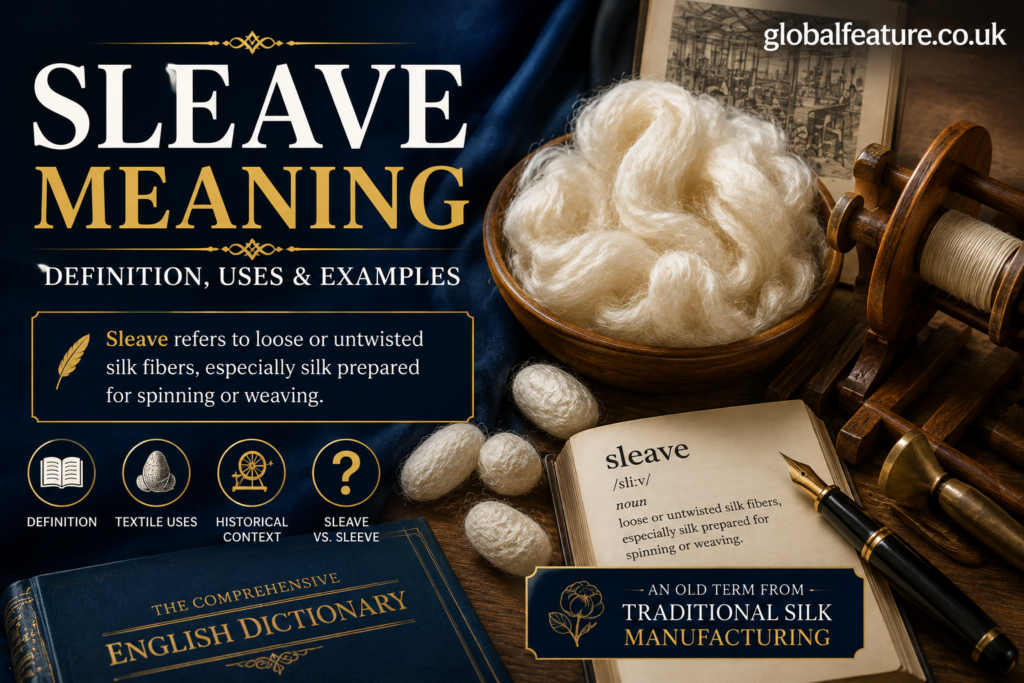

The phrase “sleave meaning” often appears when people search for the definition of an uncommon English word. In most contexts, sleave refers to loosely arranged or untwisted silk fibers, especially silk prepared for spinning or weaving. The word is relatively rare in modern English, which can make its meaning confusing. Understanding its historical use, pronunciation, and connection to textiles makes the term much easier to recognize.
What Does Sleave Mean?
The word sleave is an old or specialized English term associated mainly with silk fibers. It describes silk that has been prepared in a loose, untwisted form before being spun into thread.
Unlike finished silk thread, sleave is not tightly twisted. It consists of soft, loose fibers that can be worked into yarn or thread during the textile-making process.
The word is most commonly encountered in:
- Historical English
- Textile terminology
- Literature
- Descriptions of silk production
- Older dictionaries and writings
Because sleave is uncommon today, many English speakers may never encounter it in everyday conversation.
Sleave Meaning in Simple English
In simple terms, sleave means loose silk fibers that have not yet been twisted into thread.
A useful way to remember it is:
Sleave = loose or untwisted silk prepared for spinning.
The word belongs to an older vocabulary connected with traditional textile production. In modern English, people are much more likely to say silk fibers, silk floss, or raw silk material depending on the exact context.
Sleave Meaning in Textile Production
Historically, making silk thread involved several stages. Silk fibers needed to be gathered, prepared, and eventually twisted into usable thread.
Sleave referred to the loose material before it reached the stage of tightly formed thread.
This distinction was important because textile workers needed to handle fibers differently depending on their condition. Loose silk could be separated and prepared for spinning, while twisted silk was already closer to its finished form.
Why Was Sleave Important?
Sleave was useful because loose fibers could be transformed into stronger and more manageable thread.
The process generally involved:
- Collecting suitable silk fibers.
- Preparing and arranging the fibers.
- Keeping them loose before spinning.
- Drawing the fibers together.
- Twisting them into thread or yarn.
- Using the finished material for textiles.
This historical meaning explains why the word appears in older descriptions of silk and textile craftsmanship.
Sleave vs. Sleeve: What Is the Difference?
One of the biggest reasons people search for sleave meaning is confusion with the much more familiar word sleeve.
Although the words look and sound similar, they have different meanings.
| Word | Meaning | Common Use |
|---|---|---|
| Sleave | Loose or untwisted silk fibers | Historical textile terminology |
| Sleeve | The part of clothing covering the arm | Modern everyday English |
| Silk fiber | Individual or grouped fibers obtained from silk | Textile production |
| Thread | Fibers twisted together into a continuous strand | Sewing and weaving |
If someone writes about clothing, they almost certainly mean sleeve, not sleave. If the context involves old textile terminology or silk preparation, sleave may be the intended word.
Is Sleave a Common English Word?
No, sleave is considered an uncommon and largely historical or specialized word.
Modern speakers rarely use it in ordinary conversation. It may appear in older books, historical discussions, dictionaries, or texts dealing with traditional textile manufacturing.
That does not make the word incorrect. It simply means that its use is limited compared with everyday terms such as thread, silk, or fiber.
Why Does Sleave Sound Unfamiliar?
English contains thousands of words that have become rare because language changes over time. Some words remain in specialist fields, while others survive mainly in historical literature.
Sleave belongs to this group of less familiar vocabulary. Its connection with traditional silk preparation means it is more likely to be encountered by readers interested in:
- Historical textiles
- Literature
- Antique crafts
- Linguistics
- Old English vocabulary
- Traditional weaving
Sleave in Historical Language
Older forms of English often contained specific words for materials and manufacturing processes that modern English describes with broader terms.
Textile production was especially rich in specialized vocabulary because spinning, weaving, dyeing, and sewing involved many separate processes.
The word sleave reflects this older vocabulary. Rather than describing finished fabric, it refers to a particular state of silk before it becomes conventional thread.
This is also why understanding the surrounding sentence is important. A historical text may use sleave in a way that makes perfect sense to readers familiar with traditional textile work but seems unusual to modern readers.
How to Remember the Meaning of Sleave
A simple memory trick can make the definition easier to remember:
Sleave = silk in a loose state.
Think of the word as referring to silk fibers that are not yet tightly twisted.
You can also associate it with the stages of textile production:
Loose fibers → Sleave → Spinning → Thread → Fabric
This sequence helps distinguish sleave from the much more familiar sleeve.
Example Sentences Using Sleave
Because sleave is rare, examples can help clarify how the word works.
- The craftsman prepared the sleave before spinning the silk.
- The historical document describes the use of sleave in textile production.
- The loose silk sleave was carefully prepared for twisting.
- The museum displayed traditional tools used to work with silk sleave.
These examples show that the word is primarily connected with silk and traditional textile processes rather than clothing.
Common Mistake: Sleave or Sleeve?
When typing quickly, people sometimes write sleave when they actually mean sleeve.
For example:
Incorrect:
“The shirt has a long sleave.”
Correct:
“The shirt has a long sleeve.”
A sleeve is part of a garment. A sleave, in its historical textile sense, relates to loose silk fibers.
The difference is only one letter, but the meanings are completely different.
Why Understanding Sleave Meaning Matters
Learning uncommon words such as sleave can improve vocabulary and help readers understand older or specialized writing.
Knowing the word can be particularly useful when reading historical material where modern equivalents are not always used.
It also demonstrates an important feature of English: many words have survived even though they are no longer common in everyday speech.
Understanding these terms allows readers to interpret historical descriptions more accurately instead of assuming that an unfamiliar word is a spelling mistake.
Frequently Asked Questions
1. What is the basic sleave meaning?
Sleave generally means loose, untwisted silk fibers prepared for spinning or making thread. It is an uncommon and historical textile term.
2. Is sleave the same as sleeve?
No. Sleave and sleeve have different meanings. A sleeve is the part of clothing that covers the arm, while sleave traditionally refers to loose silk fibers.
3. Is sleave still used in modern English?
Sleave is rarely used in everyday modern English. It is more likely to appear in historical, literary, linguistic, or specialized textile contexts.
4. What type of material is sleave?
Sleave traditionally refers to silk in a loose or untwisted form before it is spun into thread.
5. How can I remember the meaning of sleave?
Remember the phrase “sleave means loose silk.” This simple association helps distinguish it from sleeve, which refers to clothing.
Conclusion
The sleave meaning is connected to an old textile term describing loose or untwisted silk fibers prepared for spinning. Although the word is uncommon today, it remains useful when reading historical texts or learning about traditional silk production. Most importantly, sleave should not be confused with sleeve. Knowing this small distinction can make unfamiliar historical vocabulary much easier to understand.