
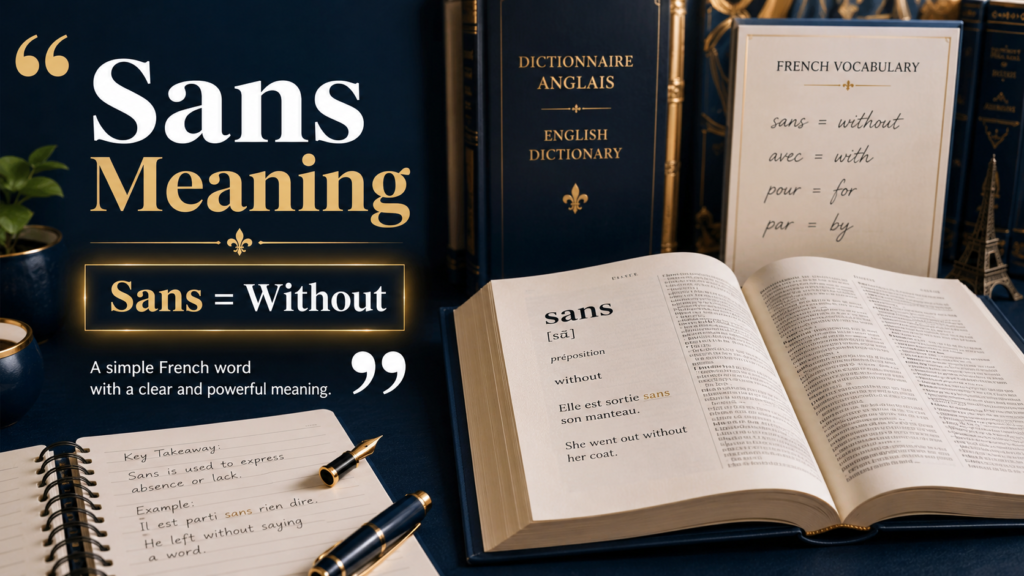

The word sans may look unfamiliar at first, but you have probably seen it in phrases such as “coffee sans sugar” or “a world sans technology.” The sans meaning is quite simple: it means “without” or “lacking.” Although it comes from French, the word is also used in English, particularly in writing, literature, fashion, design, and informal expressions.
What Does Sans Mean?
The basic sans meaning is without.
It describes the absence of a person, thing, quality, or feature. In most situations, you can replace “sans” with “without” without changing the overall meaning of the sentence.
Simple Definition
Sans = without; lacking; in the absence of something.
For example:
- “He arrived sans jacket.”
→ He arrived without a jacket. - “She ordered tea sans milk.”
→ She ordered tea without milk. - “The room was decorated sans curtains.”
→ The room was decorated without curtains.
The word is short, but it can give a sentence a slightly more stylish, literary, or sophisticated tone.
The Origin of Sans
Sans is a French preposition meaning “without.” It entered English usage from French and has remained recognizable in certain forms of English writing.
In modern French, sans is an everyday word. French speakers use it naturally in ordinary conversation and writing.
For example:
- sans sucre = without sugar
- sans problème = without a problem
- sans doute = probably / undoubtedly, depending on context
English borrowed the word but uses it much less frequently than French.
Because of its French origin, sans meaning can sometimes feel more elegant or expressive than simply saying “without.”
How Is Sans Used in English?
In English, sans is generally used before a noun or noun phrase.
The structure is simple:
sans + noun
Examples include:
- sans shoes
- sans makeup
- sans permission
- sans explanation
- sans assistance
- sans warning
Example Sentences
Here are several natural examples:
- “He left the house sans his phone.”
- “The meal was served sans dessert.”
- “She attended the event sans her usual accessories.”
- “The project was completed sans professional assistance.”
- “They traveled across the country sans a fixed itinerary.”
While some of these constructions sound more formal or playful than everyday English, the meaning remains clear.
Sans vs. Without
The most important distinction is not meaning but style and usage.
Both words generally communicate the absence of something, but “without” is much more common in everyday English.
| Word | Basic Meaning | Common Usage | Tone |
|---|---|---|---|
| Sans | Without | Writing, literature, style, informal expressions | Stylish or literary |
| Without | In the absence of | Everyday speech and writing | Neutral |
| Minus | With something removed | Numbers, quantities, casual speech | Practical |
| Lacking | Not having enough of something | Formal descriptions | Formal |
For example:
- Without: “I went to work without breakfast.”
- Sans: “I went to work sans breakfast.”
Both sentences communicate essentially the same idea. However, the second sounds more unusual and deliberately stylish.
Is Sans a Formal Word?
Sans is not necessarily formal, but it can sound sophisticated, literary, humorous, or deliberately fashionable.
Its effect depends heavily on context.
For instance:
“A burger sans onions, please.”
This sounds casual and slightly playful.
On the other hand:
“The proposal was submitted sans supporting documentation.”
This sounds more formal and literary.
In ordinary conversation, “without” is usually the safer and more natural choice.
Common Expressions With Sans
Although sans can be placed before many nouns, some combinations are more recognizable than others.
Sans Serif
One of the most famous uses of the word is sans serif.
In typography, sans serif refers to a typeface without the small decorative strokes found at the ends of letters in serif fonts.
The phrase literally means:
sans = without
serif = a decorative stroke on a letter
Therefore, “sans serif” essentially means “without serifs.”
Popular sans-serif typefaces include styles such as Arial, Helvetica, and Verdana.
Sans Makeup
The phrase “sans makeup” means without makeup.
It is often used in fashion, beauty, and entertainment writing to describe someone’s natural appearance.
Example:
“The actress appeared sans makeup in a casual photo.”
Sans Shoes
“Sans shoes” means without shoes.
This construction may be used in descriptive or humorous writing.
Example:
“The children ran across the grass sans shoes.”
Why Do Writers Use Sans?
Writers sometimes choose sans because it is concise and adds personality to a sentence.
There are several reasons someone might use it:
- It avoids repeating the word “without.”
- It creates a stylish tone.
- It can make a sentence sound literary.
- It works well in headlines and captions.
- It can add humor or sophistication.
- It is useful when describing something visually.
However, using it too often can make writing feel unnatural. Good writing depends on context, so sans should be used where it genuinely fits the tone.
Sans in Modern Culture and Design
The word appears frequently in areas such as fashion, graphic design, entertainment, journalism, and social media.
Fashion headlines may use expressions such as “sans accessories” or “sans makeup.” Food descriptions might use “sans dairy” or “sans sugar.” Designers frequently encounter the word in the phrase “sans serif.”
This makes sans more recognizable than its foreign origin might suggest.
It is particularly common when a writer wants to make a short description sound distinctive.
Common Mistakes When Using Sans
Although the word is easy to understand, a few mistakes are worth avoiding.
Using It When “Without” Sounds Better
Not every sentence benefits from sans.
For example:
“Please complete the form sans assistance.”
This is grammatically understandable, but:
“Please complete the form without assistance.”
sounds more natural in most professional situations.
Confusing Sans With “Less”
Sans means without, not necessarily “less.”
For example:
“Coffee sans sugar”
means coffee without sugar, not coffee with less sugar.
This distinction matters when describing quantities or ingredients.
FAQs About Sans Meaning
1. What does sans mean?
Sans means “without” or “in the absence of.” It comes from French and is also used in English, particularly in literary, stylish, and descriptive writing.
2. Is sans an English word?
Yes. Although sans originated in French, it has been adopted into English usage. It is commonly understood in phrases such as “sans makeup” and “sans serif.”
3. What is an example of sans?
An example is: “She arrived sans umbrella.” This means she arrived without an umbrella.
4. Is sans the same as without?
In most English contexts, yes. Sans and without generally have the same basic meaning, although “without” is much more common in everyday English.
5. What does sans serif mean?
Sans serif means “without serifs.” In typography, it describes fonts that do not have the small decorative strokes traditionally found at the ends of letters.
Conclusion
The sans meaning is simple: without, lacking, or in the absence of something. Derived from French, the word has become part of English vocabulary and is often used to create a stylish, literary, or playful tone. From “sans makeup” to “sans serif,” it appears in everyday expressions, fashion, design, and writing. Understanding this small but useful word can make unfamiliar phrases much easier to understand.