
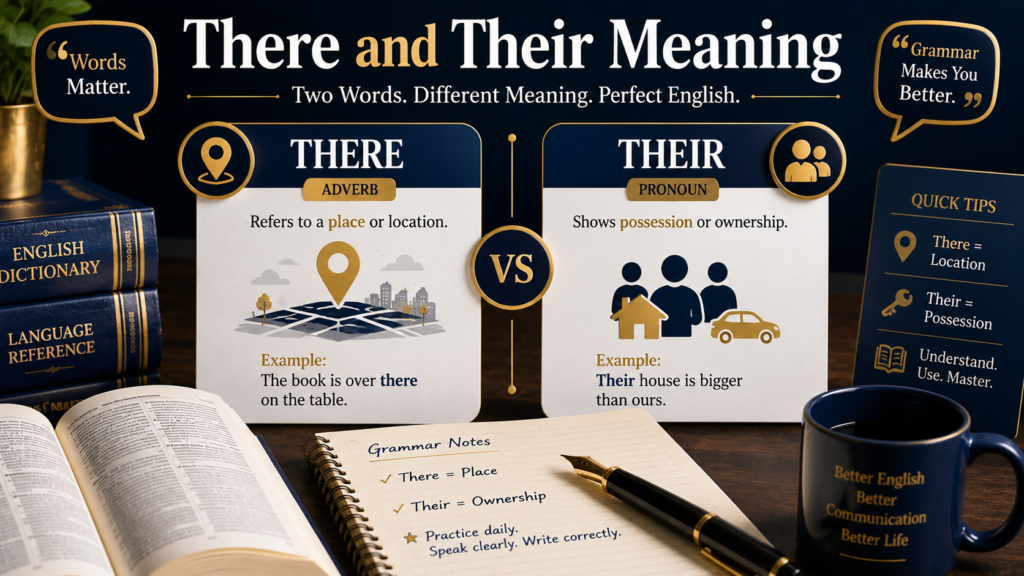

The words there and their sound exactly alike, but they have completely different meanings and uses. This makes them one of the most common sources of confusion in English writing. Understanding the difference between there and their meaning can help you write clearer emails, messages, essays, and everyday sentences. The good news is that the rule is simple once you know what each word does.
There and Their Meaning Explained
The easiest way to understand these two words is to remember their basic functions.
- There usually refers to a place, position, or existence.
- Their shows possession or ownership.
Although both words are pronounced the same way, they cannot normally be substituted for each other.
For example:
- The keys are over there.
- The students left their books in the classroom.
In the first sentence, “there” identifies a location. In the second sentence, “their” tells us that the books belong to the students.
What Does “There” Mean?
There is commonly used to talk about a location. It can point to a particular place that is away from the speaker or listener.
Examples of “There” for Location
Consider these examples:
- Please put the bag over there.
- My brother is standing there.
- We went there last weekend.
- The restaurant is just over there.
- I left my phone there.
In each sentence, “there” has a connection with a place.
However, “there” has another important grammatical use. It can introduce the existence or presence of something.
“There” to Show Existence
Examples include:
- There is a problem with the computer.
- There are three books on the table.
- There was a loud noise outside.
- There were many people at the event.
Here, “there” does not necessarily mean a physical location. Instead, it helps introduce something that exists or happens.
This is why simply remembering “there means a place” is useful but not always enough. Its grammatical role can also be to introduce a statement about existence.
What Does “Their” Mean?
Their is a possessive word. It shows that something belongs to, is connected with, or is associated with more than one person.
For example:
- The children packed their bags.
- The workers finished their project.
- The students submitted their assignments.
- The players celebrated their victory.
- The neighbors painted their house.
In these examples, “their” indicates ownership or association.
Their Can Refer to One Person
In modern English, their can also be used as a singular possessive pronoun when the person’s gender is unknown, unspecified, or when someone uses “they” pronouns.
For example:
- Someone left their umbrella here.
- Every employee should bring their identification.
- If a customer has a question, their concern should be addressed.
This use is now very common in everyday and professional English.
There vs. Their: Quick Comparison
| Word | Main Meaning | Function | Example |
|---|---|---|---|
| There | A place or existence | Location or introductory word | The car is over there. |
| Their | Belonging to someone | Possessive determiner | They washed their car. |
The key distinction is simple: there points to a place or introduces existence, while their indicates possession.
How to Remember the Difference
One of the easiest ways to remember there and their meaning is to connect each word with another familiar word.
Remember “There” With “Here”
Both there and here can refer to places.
- Come here.
- Go there.
If you are talking about a location, there is probably the correct choice.
Remember “Their” With “Our”
Both their and our can show possession.
- Our house
- Their house
If the word describes who owns or is connected to something, use their.
Another useful trick is to look at the word that follows it. If you can replace “their” with “our” or “his/her,” you are probably dealing with possession.
For example:
They brought their lunch.
You could say:
They brought their lunch.
We brought our lunch.
That confirms that “their” expresses possession.
Common Mistakes With There and Their
Because the two words sound identical, people often make mistakes when writing them.
Incorrect:
Their is a new shop downtown.
Correct:
There is a new shop downtown.
The sentence is introducing the existence of a shop, so “there” is required.
Another example:
Incorrect:
The children left there shoes outside.
Correct:
The children left their shoes outside.
The shoes belong to the children, so “their” is correct.
What About “They’re”?
There is a third word that often creates even more confusion: they’re.
They’re is a contraction of they are.
For example:
- They’re coming home soon.
- They’re very happy.
- They’re working on a new project.
A simple comparison makes the difference clearer:
- There = place or existence
- Their = possession
- They’re = they are
Easy Examples
Compare these sentences:
- They’re going over there with their friends.
- There are several students with their teachers.
- They’re leaving their bags over there.
Once you identify each word’s function, the correct spelling becomes much easier to choose.
Why This Difference Matters
Knowing the difference between there and their may seem like a small grammar detail, but it can significantly improve written communication.
Using the wrong word can make a sentence look careless or confusing, particularly in:
- School assignments
- Business emails
- Job applications
- Website content
- Social media posts
- Professional documents
English readers usually understand what you mean from context, but using the correct word makes your writing more polished and credible.
A Simple Practice Exercise
Try choosing the correct word in each sentence:
- The students forgot ___ homework.
- Please wait over ___.
- ___ are going to the store.
- ___ is a problem with the printer.
- The team celebrated ___ success.
Answers
- their
- there
- they’re
- there
- their
Practicing short examples like these is an effective way to make the distinction automatic.
Final Tips for Remembering There and Their
Keep these three rules in mind:
- Use there when referring to a place: “The book is over there.”
- Use there when introducing existence: “There are two options.”
- Use their when showing possession: “They brought their books.”
- Use they’re when you mean “they are”: “They’re ready.”
The most important step is to focus on the meaning of the sentence rather than how the word sounds.
FAQs About There and Their Meaning
1. What is the main difference between there and their?
There is generally used for a place or to introduce the existence of something, while their shows possession or association. For example, “The car is there” uses “there” for location, while “They washed their car” uses “their” to show ownership.
2. Is there a simple trick to remember their?
Yes. Think of their as a possessive word similar to our. If you can replace the word with “our,” “his,” or “her” and the sentence still makes sense, “their” may be correct.
3. Can there be used without referring to a place?
Yes. “There” can introduce the existence of something. For example, “There is a new message” does not use “there” to identify a particular location.
4. What does they’re mean?
They’re is a contraction of they are. For example, “They’re ready” means “They are ready.” It is different from both “there” and “their.”
5. Why are there, their, and they’re often confused?
They are homophones, meaning they sound alike when spoken but have different spellings and meanings. Because pronunciation does not help distinguish them, writers must understand their grammatical functions.
Conclusion
Understanding there and their meaning becomes much easier when you focus on what each word does. There usually relates to a place or introduces existence, while their shows possession. Remembering the connection between “there” and “here,” and between “their” and “our,” can help you avoid common mistakes. With regular practice, choosing the correct word will quickly become natural.