
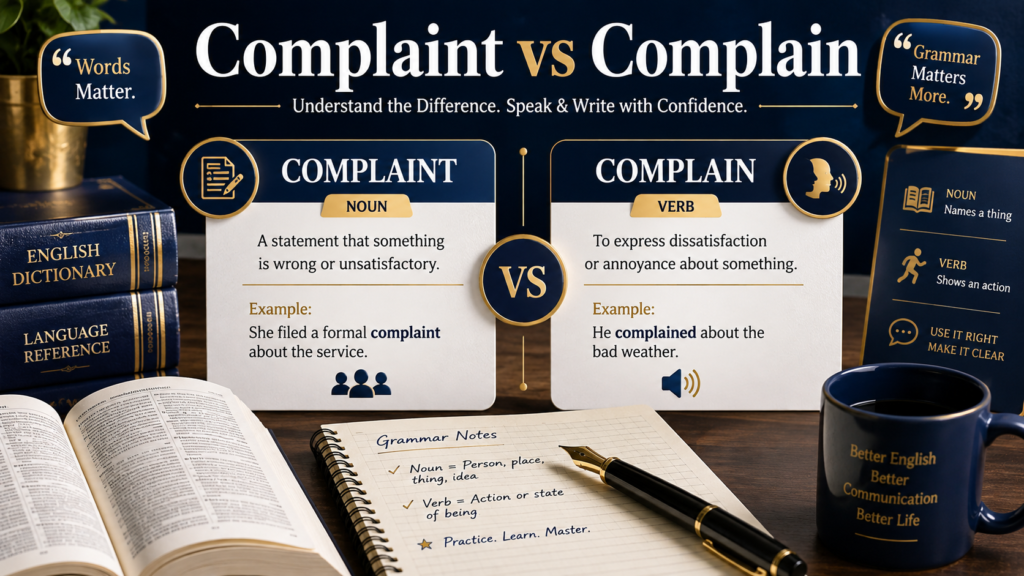

Understanding the difference between complaint vs complain can make everyday English much easier. Although these two words look and sound closely related, they have different grammatical roles and are used in different ways. Complaint is a noun, while complain is a verb. Once you understand this simple distinction, choosing the correct word in a sentence becomes much easier.
Complaint vs Complain: What Is the Difference?
The main difference between complaint and complain is their function in a sentence.
Complaint refers to an expression of dissatisfaction. It is a noun, meaning it describes the thing that someone expresses or makes.
Complain describes the action of expressing dissatisfaction. It is a verb, meaning it tells us what someone does.
For example:
- She made a complaint about the service.
- She decided to complain about the service.
Both sentences communicate a similar idea, but the grammatical structure is different.
What Does “Complaint” Mean?
A complaint is a statement or expression that something is wrong, unsatisfactory, unfair, or unpleasant.
Because complaint is a noun, it can usually appear after words such as a, the, my, your, or their.
Examples of “Complaint”
- I have a complaint about the product.
- The customer submitted a formal complaint.
- His complaint was taken seriously.
- We received several complaints about the noise.
- She made a complaint to the manager.
Notice that the word describes the issue or statement itself rather than the action of expressing dissatisfaction.
Common Expressions With Complaint
Some common phrases include:
- Make a complaint
- File a complaint
- Submit a complaint
- Receive a complaint
- Handle a complaint
- Formal complaint
- Customer complaint
- Written complaint
For example, you might say, “The customer decided to file a complaint.”
What Does “Complain” Mean?
Complain is a verb. It means to express dissatisfaction, annoyance, or disagreement about something.
Since it is an action word, it normally appears with a subject.
Examples of “Complain”
- I often complain about the weather.
- She complained about the long wait.
- They are complaining about the price.
- He complained to the manager.
- We should not complain without offering a solution.
The form can change depending on the tense:
- Present: complain
- Past: complained
- Present participle: complaining
- Third-person singular: complains
Complaint vs Complain: Quick Comparison
| Feature | Complaint | Complain |
|---|---|---|
| Part of speech | Noun | Verb |
| Meaning | An expression of dissatisfaction | The act of expressing dissatisfaction |
| Example | I made a complaint. | I complained to the manager. |
| Common form | A complaint | To complain |
| Plural form | Complaints | Complains |
| Past tense | Not applicable as a noun | Complained |
The easiest way to remember the difference is to ask yourself whether you are talking about the thing or the action.
How to Use “Complaint” Correctly
Use complaint when you are naming the dissatisfaction itself.
For instance:
The hotel received a complaint from a guest.
Here, the complaint is something the hotel received.
Another example is:
Her complaint was about the poor customer service.
The word “complaint” identifies the statement or issue.
Complaint in Formal English
The noun complaint is especially common in professional and formal situations.
For example:
- The company investigated the customer’s complaint.
- Your complaint has been forwarded to the relevant department.
- We apologize for the inconvenience mentioned in your complaint.
These sentences focus on the issue that has been reported.
How to Use “Complain” Correctly
Use complain when someone is performing the action of expressing dissatisfaction.
For example:
The customer complained about the delayed delivery.
Here, “complained” describes what the customer did.
You can also use complain with different prepositions depending on the sentence.
Complain About
Use complain about when identifying the thing that causes dissatisfaction.
- She complained about the noise.
- He complained about the food.
- They complained about the service.
Complain To
Use complain to when identifying the person or organization receiving the complaint.
- She complained to the manager.
- He complained to the company.
- They complained to the teacher.
You can use both together:
The customer complained to the manager about the service.
Common Mistakes With Complaint and Complain
Because these words are related, English learners sometimes use one where the other is required.
Incorrect: “I have a complain.”
The correct sentence is:
I have a complaint.
The word after “a” should be the noun complaint.
Incorrect: “I want to complaint.”
The correct sentence is:
I want to complain.
After “to,” use the base form of the verb, so complain is correct.
Incorrect: “She made a complain.”
The correct version is:
She made a complaint.
The phrase “make a complaint” requires the noun.
Easy Trick to Remember the Difference
A simple memory trick can help:
Complaint = thing
Complain = action
If you can put “a” before the word, you probably need complaint:
- a complaint
- a serious complaint
- a customer complaint
If you need an action after “to”, use complain:
- to complain
- to complain about something
- to complain to someone
Think of the pair this way:
You complain when you make a complaint.
That sentence shows the relationship between the two words while keeping their grammatical roles clear.
Complaint vs Complain in Everyday English
Both words are common in conversations, workplaces, customer service, and formal communication.
Consider these examples:
- “I want to complain about this order.”
- “I would like to make a complaint about this order.”
The first sentence emphasizes the action. The second emphasizes the formal expression of dissatisfaction.
In casual conversation, complain is often more natural. In official situations, complaint frequently appears in written or formal language.
Why Knowing the Difference Matters
Using complaint and complain correctly improves both grammar and clarity. The difference is small, but choosing the wrong form can make a sentence sound unnatural.
This distinction is useful when:
- Writing customer service messages
- Preparing workplace emails
- Speaking about problems
- Completing English grammar exercises
- Writing formal documents
- Improving everyday vocabulary
Learning related noun-and-verb pairs like this can also make your English more precise.
FAQs About Complaint vs Complain
1. What is the main difference between complaint and complain?
Complaint is a noun referring to an expression of dissatisfaction, while complain is a verb describing the action of expressing dissatisfaction.
2. Is “complaint” a noun or a verb?
Complaint is a noun. For example, “The manager received a complaint.”
3. Is “complain” a noun or a verb?
Complain is a verb. For example, “The customer decided to complain.”
4. Which is correct: “make a complaint” or “make a complain”?
The correct phrase is “make a complaint.” Complaint is the noun needed after “make a.”
5. Which is correct: “I want to complain” or “I want to complaint”?
The correct sentence is “I want to complain.” After “to,” the base form of the verb is required.
Conclusion
The difference between complaint vs complain is simple once you understand their grammatical roles. Complaint is a noun representing an expression of dissatisfaction, while complain is a verb describing the act of expressing dissatisfaction. Remember the simple rule: you complain, but you make a complaint. Using this distinction correctly will make your spoken and written English clearer and more natural.