
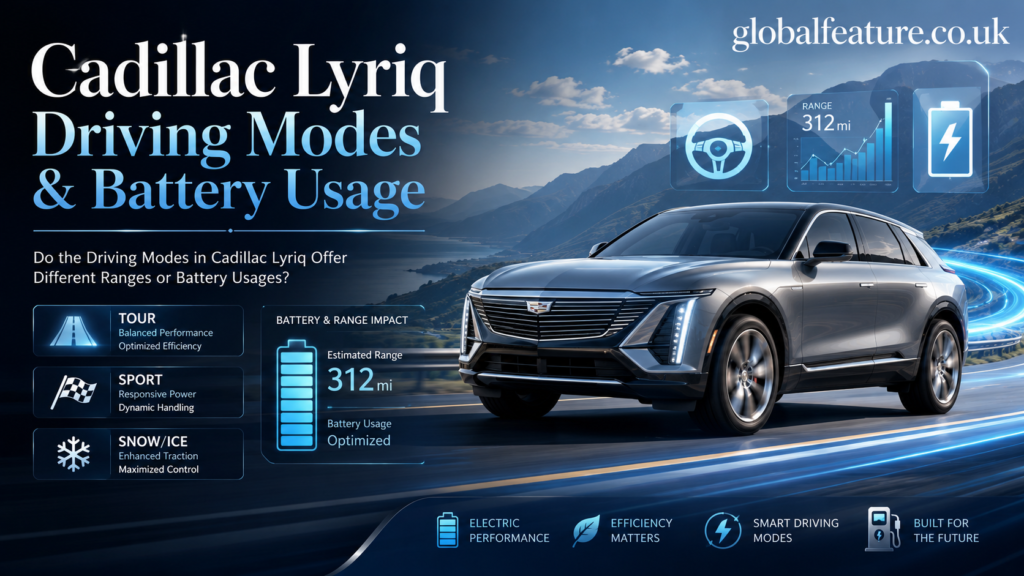

Electric vehicles are becoming smarter every year, and the Cadillac Lyriq is one of the best examples of advanced EV technology. One of the most common questions among new buyers is:
Do the driving modes in Cadillac Lyriq offer different ranges or battery usages?
The short answer is yes—but indirectly. Driving modes don’t magically increase or decrease the battery’s capacity. Instead, they adjust how the vehicle delivers power, acceleration, regenerative braking, steering feel, and traction control. These changes can influence how efficiently the battery is used, ultimately affecting your driving range.
This guide explains exactly how each driving mode works and how it impacts battery consumption and real-world efficiency.
Understanding Cadillac Lyriq Driving Modes
The Cadillac Lyriq offers multiple selectable driving modes designed for different road conditions and driving styles.
| Driving Mode | Best For | Battery Efficiency |
|---|---|---|
| Tour | Daily driving | Excellent |
| Sport | Fast acceleration | Lower efficiency |
| Snow/Ice | Slippery roads | Moderate |
| My Mode | Personalized settings | Depends on configuration |
Each mode changes the vehicle’s software rather than the battery itself.
Does the Battery Capacity Change?
No.
The Cadillac Lyriq’s battery capacity remains exactly the same regardless of the selected driving mode.
Instead, the system modifies:
- Accelerator sensitivity
- Motor power delivery
- Steering response
- Traction control
- Regenerative braking characteristics
- AWD torque distribution (on AWD models)
These adjustments affect how much electricity the motors consume while driving.
Tour Mode: Best for Maximum Range
Tour Mode is the default setting and is designed for everyday driving.
It delivers:
- Smooth acceleration
- Balanced steering
- Efficient motor output
- Optimized regenerative braking
Because acceleration is more gradual, drivers naturally consume less energy.
Benefits
- Highest efficiency
- Best highway performance
- Longer battery range
- Comfortable driving
For most owners, Tour Mode offers the greatest real-world driving range.
Sport Mode: More Performance, Higher Battery Usage
Sport Mode transforms the Lyriq into a quicker, more responsive SUV.
Changes include:
- Sharper throttle response
- Faster acceleration
- Increased motor torque
- Heavier steering feel
Although exciting, aggressive acceleration requires more electricity.
Why Range Decreases
Every hard acceleration draws high power from the battery.
Even though Sport Mode itself doesn’t waste electricity, it encourages driving habits that use more energy.
Typical impacts include:
- Faster battery drain
- Reduced efficiency
- Slightly lower driving range
Snow/Ice Mode
Snow/Ice Mode prioritizes safety instead of efficiency.
It reduces wheel spin by:
- Softening accelerator response
- Limiting torque
- Improving traction
- Stabilizing power delivery
While efficiency remains good, energy usage may increase in winter because:
- Cold batteries are less efficient.
- Cabin heating uses additional power.
- Road resistance increases.
My Mode
My Mode lets drivers customize several vehicle settings.
You can adjust:
- Steering feel
- Acceleration response
- Brake characteristics
Battery usage depends on the selected preferences.
Choosing softer acceleration usually improves efficiency.
Does Regenerative Braking Affect Range?
Absolutely.
One of the Lyriq’s best features is regenerative braking.
Instead of wasting energy while slowing down, the electric motors recover some of that energy and send it back into the battery.
Benefits include:
- Better efficiency
- Less brake wear
- Increased city driving range
Using One-Pedal Driving can recover even more energy during stop-and-go traffic.
Highway vs City Driving
Driving mode matters differently depending on where you drive.
| Driving Situation | Recommended Mode | Expected Efficiency |
|---|---|---|
| City Traffic | Tour | Excellent |
| Highway | Tour | Very Good |
| Mountain Roads | Tour / My Mode | Good |
| Spirited Driving | Sport | Lower |
| Snowy Roads | Snow/Ice | Safety Priority |
Factors That Affect Range More Than Driving Mode
Although driving modes have some influence, these factors make a much bigger difference.
Speed
Driving above 70 mph dramatically increases battery consumption.
Weather
Cold temperatures reduce battery efficiency.
Tire Pressure
Underinflated tires increase rolling resistance.
Air Conditioning and Heating
Climate control can noticeably affect driving range.
Cargo Weight
Extra passengers and heavy cargo require additional energy.
Driving Style
Smooth acceleration is the biggest contributor to maximum EV range.
Estimated Energy Impact
Although Cadillac doesn’t publish exact percentage differences between modes, real-world EV testing suggests the following trends.
| Driving Habit | Relative Battery Usage |
|---|---|
| Smooth Tour Mode Driving | Lowest |
| Moderate My Mode | Low |
| Snow/Ice Mode | Moderate |
| Aggressive Sport Driving | Highest |
The difference typically comes from driver behavior rather than software limitations.
Tips to Maximize Cadillac Lyriq Range
If your goal is maximum driving distance:
- Use Tour Mode whenever possible.
- Accelerate gently.
- Take advantage of regenerative braking.
- Use One-Pedal Driving.
- Keep tires properly inflated.
- Precondition the battery before long trips.
- Reduce unnecessary cargo weight.
- Avoid rapid acceleration.
Common Misconceptions
Myth: Sport Mode drains the battery automatically.
Reality: It encourages more aggressive acceleration, which consumes more electricity.
Myth: Tour Mode increases battery capacity.
Reality: It simply delivers power more efficiently.
Myth: Driving modes permanently affect battery health.
Reality: Battery health depends far more on charging habits, temperature, and long-term usage than on driving mode selection.
Is Sport Mode Bad for the Battery?
No.
Using Sport Mode occasionally will not damage the battery.
Modern battery management systems carefully monitor:
- Temperature
- Voltage
- Charging rates
- Power output
The system protects the battery regardless of the selected driving mode.
Which Driving Mode Should You Use?
For most drivers:
- Tour Mode is ideal for everyday commuting and maximizing range.
- Sport Mode is perfect when you want quicker acceleration and a more engaging driving experience.
- Snow/Ice Mode provides added confidence in slippery conditions.
- My Mode offers a balance by letting you personalize the vehicle to your preferences.
Conclusion
So, do the driving modes in Cadillac Lyriq offer different ranges or battery usages?
Yes—but not because they change the battery itself. Instead, each mode adjusts how the vehicle delivers power, responds to driver inputs, and manages traction. These changes influence energy consumption, meaning Tour Mode generally delivers the best efficiency, while Sport Mode can reduce range if driven aggressively.
Ultimately, your driving habits have a greater impact on battery usage than the selected driving mode. Smooth acceleration, effective use of regenerative braking, and proper vehicle maintenance will help you achieve the longest possible range from your Cadillac Lyriq.
Frequently Asked Questions (FAQs)
Do driving modes change the Cadillac Lyriq battery capacity?
No. Driving modes do not alter the battery’s physical capacity. They only modify vehicle performance characteristics such as throttle response, steering, and traction control.
Which Cadillac Lyriq mode provides the best range?
Tour Mode generally offers the best range because it promotes smooth acceleration and efficient power delivery.
Does Sport Mode consume more battery?
Sport Mode can lead to higher energy consumption because it enables faster acceleration and more aggressive driving, which requires additional power.
Is Snow/Ice Mode less efficient?
Not necessarily. Snow/Ice Mode focuses on traction and safety. However, winter conditions themselves—such as cold temperatures and cabin heating—can reduce overall driving range.
Does regenerative braking increase range?
Yes. Regenerative do the driving modes in cadillac lyriq offer different ranges or battery usages? braking recovers energy during deceleration and returns it to the battery, helping improve efficiency, especially in city driving.