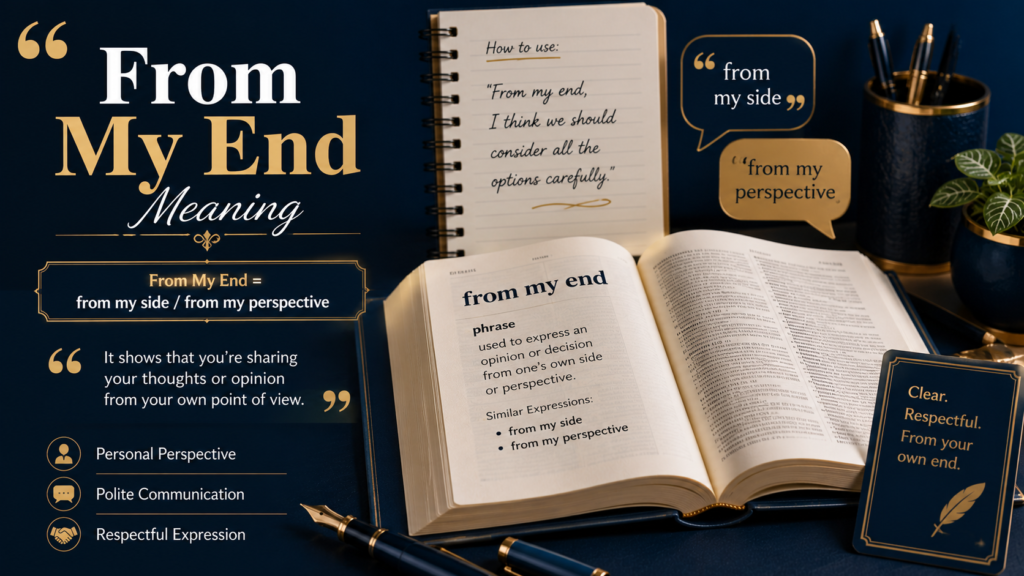

The phrase “from my end” is commonly used in everyday English, especially in conversations about work, communication, tasks, and responsibilities. It generally means “from my side,” “as far as I am concerned,” or “regarding what I can do.” Understanding the from my end meaning can help you communicate more clearly and naturally in professional and casual situations.
What Is the Meaning of “From My End”?
“From my end” means something is being considered or handled from the speaker’s side or perspective.
In simple words, it can mean:
- From my side
- On my side
- As far as I am concerned
- Regarding my responsibilities
- Based on what I have done or can do
For example:
“Everything is ready from my end.”
This means the speaker has completed everything they are responsible for and believes there is nothing more they need to do.
Another example is:
“There are no issues from my end.”
Here, the speaker is saying that they do not have any problems or concerns.
From My End Meaning in Different Situations
The exact meaning can change slightly depending on the context. However, the central idea remains the same: the speaker is referring to their own side, responsibility, opinion, or situation.
In the Workplace
“From my end” is particularly common in professional communication.
For example:
“The report has been completed from my end.”
This means the speaker has finished their part of the report.
Another example:
“The changes have been made from my end.”
This tells colleagues that the speaker has completed the requested changes.
It is useful when several people are working on the same project and each person has different responsibilities.
In Everyday Conversation
The phrase can also appear in informal conversations.
For example:
“There is no problem from my end.”
This simply means “I have no problem with it.”
You might also hear:
“Everything is fine from my end.”
This means the speaker is satisfied with the situation.
When Discussing Responsibilities
The phrase can emphasize that someone has done their part.
For example:
“I have submitted the documents from my end.”
The speaker is explaining that they have completed their responsibility, although another person or department may still need to take action.
“From My End” vs. “From My Side”
The phrases “from my end” and “from my side” are very similar. In many situations, they can be used interchangeably.
However, “from my end” is especially common when discussing tasks, work, technical matters, or responsibilities.
| Phrase | Common Meaning | Example |
|---|---|---|
| From my end | From my side or responsibility | “The task is complete from my end.” |
| From my side | From my perspective or position | “There is no issue from my side.” |
| On my end | Regarding my situation or system | “Everything is working on my end.” |
| As far as I’m concerned | According to my opinion | “As far as I’m concerned, the plan is fine.” |
These expressions are related, but their natural usage can depend on the situation.
Examples of “From My End”
Learning through examples is one of the easiest ways to understand the phrase.
Here are several natural examples:
- “Everything is ready from my end.”
- “The payment has been processed from my end.”
- “I have completed the assignment from my end.”
- “There is no problem from my end.”
- “The file has been sent from my end.”
- “The necessary updates have been made from my end.”
- “Everything looks good from my end.”
- “I have shared all the information from my end.”
- “The issue has been resolved from my end.”
- “Nothing else is required from my end.”
These examples show how the phrase can describe completed work, agreement, responsibility, or the speaker’s current situation.
Is “From My End” Grammatically Correct?
Yes, “from my end” is widely used and understandable in modern English.
However, whether it sounds natural depends on the sentence.
For example:
“Everything is complete from my end.”
This is understandable and commonly used.
In some contexts, a more natural alternative might be:
“Everything is complete on my side.”
or:
“I have completed everything.”
The simplest version is often the clearest, particularly in formal writing.
Professional vs. Casual Usage
In professional communication, “from my end” can be useful when you need to clarify responsibility.
For example:
“The requested changes have been completed from my end.”
In casual conversation, you may simply say:
“I’ve finished my part.”
Both communicate a similar idea, but the second sounds more conversational.
Common Alternatives to “From My End”
Depending on the situation, you can replace “from my end” with several expressions.
1. From My Side
This is probably the closest alternative.
Example:
“There are no concerns from my side.”
2. On My End
This is common when talking about systems, devices, tasks, or personal circumstances.
Example:
“The website is working fine on my end.”
3. As Far as I’m Concerned
This focuses more on personal opinion or judgment.
Example:
“As far as I’m concerned, the proposal looks good.”
4. On My Part
This is useful when talking about responsibility.
Example:
“Everything has been completed on my part.”
5. I Have Done My Part
This is a direct and simple expression.
Example:
“I have done my part, so the project is ready for the next step.”
Common Mistakes to Avoid
Although the phrase is easy to understand, it can sometimes be overused.
Avoid Repeating It
Using “from my end” in every sentence can make professional communication sound repetitive.
Instead of:
“The email is sent from my end. The file is ready from my end. The changes are complete from my end.”
You could write:
“I’ve sent the email, prepared the file, and completed the changes.”
This sounds more direct and natural.
Choose the Right Alternative
Use the expression that best fits your meaning.
If you are talking about responsibility, “on my part” may be better.
If you are talking about your personal perspective, “from my perspective” may be clearer.
If you are talking about a technical problem, “on my end” is often more natural.
Why Do People Use “From My End”?
People use this phrase because it clearly identifies which person or side is being discussed.
In a group project, for example, several people may be responsible for different tasks. Saying:
“The design is complete from my end.”
makes it clear that the speaker has completed their portion, while another person may still have work to do.
It can also prevent misunderstandings by separating one person’s responsibility from the overall status of a project.
FAQs About From My End Meaning
1. What does “from my end” mean?
“From my end” generally means from my side, responsibility, or perspective. It is often used when discussing completed tasks, opinions, or situations.
2. Is “from my end” correct English?
Yes. “From my end” is commonly used in modern English, particularly in workplace and everyday communication. However, simpler alternatives may sometimes sound more natural.
3. What is another way to say “from my end”?
Common alternatives include “from my side,” “on my end,” “on my part,” and “as far as I’m concerned.” The best choice depends on the context.
4. What does “everything is fine from my end” mean?
It means everything is fine from the speaker’s perspective or side. The speaker is saying that they do not see any problems.
5. What does “completed from my end” mean?
It means the speaker has completed the part of a task they were responsible for. Other people may still need to complete their own portions.
Conclusion
The from my end meaning is simple: it usually refers to something from the speaker’s side, responsibility, or perspective. The expression is especially common in workplace communication, project discussions, and everyday conversations. While alternatives such as “from my side,” “on my end,” or “on my part” can sometimes sound more natural, “from my end” remains a useful and widely understood expression when used in the right context.